

Virtual CFO Services in Australia Led by Chartered Accountants
See the Numbers Behind Your Next Growth Decision Before You Commit
Whether you are building a startup, scaling a growing business or leading an established company into its next stage, SAQCH Partners helps you see the cash, margin, tax and funding impact of your next decision before you commit to it.
Virtual CFO services help founders, owners and directors move from “I think we can afford it” to “the numbers support this decision.” We combine rolling cash forecasts, executive dashboards, board-ready reporting and Chartered Accountant-led guidance so you can hire, fund, expand and protect margin with confidence.
For early-stage, scaling and established businesses, the problem is rarely a lack of transactions. It is the absence of one senior finance leader accountable for runway, cash flow, profitability, reporting discipline and the financial consequences of the next growth decision.
Chartered Accountant-led expertise and Xero partner capabilities from our Parramatta/Sydney base, delivered through cloud reporting and advisory meetings to businesses across Australia.
 Chartered Accountant-led CFO advisory for startups, growing and established Australian businesses
- ● A rolling 12-week cash forecast that shows available cash after tax, payroll, suppliers, debt and planned investments.
- ● Margin reporting by job, project, practitioner, client or service line—before leakage becomes an EOFY surprise.
- ● Executive dashboards and board-ready reports that turn accounting data into clear director actions.
A focused review of your current cash visibility, reporting delays, margin risks and the next major financial decision facing your business.
Is Your Finance Function Keeping Pace With Your Scale?
Growth increases the speed and cost of financial mistakes. These are the warning signs that bookkeeping and annual compliance are no longer giving management enough control.
The Growth Blind Spot and Margin Leak Trap
Scenario A — The Growth Blind Spot: Sales are rising, the profit and loss looks healthy, yet available cash keeps shrinking. Debtor timing, stock, payroll, tax, supplier terms and debt commitments are consuming working capital faster than the business can replace it.
Scenario B — The Margin Leak Trap: Top-line growth hides underquoted work, labour overruns, unbilled variations, weak overhead recovery or falling practitioner utilisation. By the time the issue appears in year-end accounts, the margin has already left the business.

The Disconnected Advisor Gap
Scenario C — The Disconnected Advisor Gap: Your bookkeeper records the past. Your tax accountant handles historical compliance. Operations hold their own spreadsheets. No one owns the rolling model that connects sales, delivery capacity, margins, tax, cash and capital decisions.
The result is management by instinct: hiring before capacity is proven, buying equipment before cash impact is tested, or approaching investors and lenders with figures that do not reconcile.
A fractional CFO closes that gap by creating one financial operating rhythm, one source of truth and one accountable senior adviser focused on what happens next.

Move From Financial Reporting to Financial Control
Historical accounts confirm what happened. CFO leadership explains why it happened, what the current trajectory means and which action protects cash or margin now.
We connect Xero data with operational drivers such as sales conversion, debtor timing, labour capacity, project delivery, practitioner utilisation, tax commitments and planned capital expenditure. That creates a financial model management can actually use.
SAQCH Partners combines Chartered Accountant-led commercial judgement with Xero partner capabilities from Parramatta/Sydney, supporting Australian businesses through structured cloud reporting, monthly decision meetings and accountable follow-through.
The Minimum Finance Controls for a Scaling Business
- ✓ A rolling 12-week cash forecast updated against actual results
- ✓ Clear separation of free cash from BAS, PAYG, payroll and debt commitments
- ✓ Margin reporting by job, client, practitioner or service line
- ✓ Monthly close deadlines with reconciled, decision-ready numbers
- ✓ Budget versus actual reporting with material variances explained
- ✓ KPI scorecards linked to cash, capacity and profitability
- ✓ Scenario modeling before hiring, expansion or major capital spend
- ✓ Board-grade reporting for owners, lenders and investors

Why Choose a Chartered Accountant-Led Virtual CFO?
Many providers promise dashboards. SAQCH Partners strengthens the decision layer behind the dashboard: cash discipline, tax-aware timing, margin protection, funding readiness and board-grade commercial judgement led by Chartered Accountant capability.
Stronger Professional Judgement
- Beyond bookkeeping: Transactions are converted into management decisions, not just historical reports.
- Tax-aware timing: BAS, PAYG, superannuation, debt and working-capital commitments are built into cash planning.
- Commercial challenge: Hiring, pricing, expansion and capital expenditure are tested before the business commits cash.
Cleaner Reporting Discipline
- Month-end control: Reconciled numbers, close deadlines and clear ownership reduce reporting noise.
- Board-grade packs: Owners, lenders and investors see the same version of cash, profit, risk and next actions.
- Forecast accountability: Assumptions are reviewed against actuals so management learns faster.
Decision Support Competitors Often Miss
- Cash runway: See the weeks where pressure appears before the bank balance becomes the warning system.
- Margin leakage: Identify underquoted work, labour overruns and overhead under-recovery while action is still possible.
- Funding readiness: Prepare reconciled history, forecast scenarios and defensible assumptions before approaching lenders.
Virtual CFO Support Built Around Your Stage of Growth
Startups, scaling businesses and established companies do not need the same financial rhythm. SAQCH Partners adapts the Virtual CFO service to the decisions, risks and reporting maturity of your current stage.
Startups Building Financial Control Early
- What you may be facing: You are managing burn rate, founder decisions, early hiring, product validation, investor expectations or limited runway.
- What you need to see: cash runway, budget discipline, funding requirements, unit economics, basic KPI reporting and realistic financial assumptions.
- How SAQCH helps: We help you build investor-ready reporting, forecast cash needs, test hiring decisions and create a finance rhythm before growth becomes messy.
Growing Businesses Scaling With More Complexity
- What you may be facing: Revenue is increasing, but payroll, tax, supplier commitments, debtor timing and operational pressure are increasing with it.
- What you need to see: 12-week cash flow, budget versus actuals, margin by service or project, hiring affordability and the real cost of growth.
- How SAQCH helps: We turn Xero data into management dashboards, monthly CFO meetings and decision models so growth does not quietly consume cash.
Established Businesses Preparing for the Next Move
- What you may be facing: The business is already operating, but larger decisions now involve funding, expansion, multiple entities, leadership reporting or profit optimisation.
- What you need to see: board-grade reporting, scenario modelling, funding readiness, tax-aware cash planning, entity-level performance and capital allocation discipline.
- How SAQCH helps: We give directors a clearer financial command centre so major decisions are tested before cash, margin or governance risk is committed.
The 4-Stage Fractional CFO Advisory Protocol
A structured onboarding sequence that turns unreliable historical data into a finance function management can use to direct growth.
Structural & Data Diagnostic
Audit Xero ledger integrity, reporting systems, entity flows, internal controls, close delays and the decisions currently being made without reliable evidence.
Financial Infrastructure Hardening
Rebuild month-end close cycles, chart-of-accounts logic, reconciliations, reporting ownership and cloud workflows so management receives clean numbers on time.
Forward Modeling & Architecture
Construct the rolling 12-week cash forecast, baseline budget, scenario models and KPI scorecards linked to the business model and operating plan.
Execution & Board-Grade Direction
Deliver monthly board packs, run margin and variance reviews, challenge assumptions and guide hiring, funding, pricing and capital allocation decisions.
Ongoing Leadership Rhythm
The four stages establish the system. The recurring CFO cycle updates assumptions, tracks actions and keeps management focused as conditions change.
Your First 30 Days with SAQCH Partners
Your first month is designed to make the service tangible quickly. By the end of the first cycle, you should understand where cash is going, which margins need attention, what reports can be trusted and which growth decisions are financially safe to make next.
Week 1: We Find the Financial Blind Spots
- We review the current finance setup: Xero file quality, reporting delays, chart of accounts, debtor control, tax commitments, payroll timing and management reporting gaps.
- You see the real issue clearly: whether the pressure is coming from cash timing, weak margins, messy data, slow reporting or decisions being made without reliable numbers.
- Immediate outcome: a clear priority list showing what must be fixed first to create reliable financial visibility.
Weeks 2–3: Your First CFO View Takes Shape
- We build the working model: rolling cash forecast, key management reports, budget-versus-actual structure and margin views by client, project, practitioner or service line.
- You stop relying on the bank balance alone: available cash is separated from BAS, PAYG, payroll, superannuation, supplier payments, debt and planned investment.
- Immediate outcome: management can see what is likely to happen next—not only what happened last month.
Week 4: Your First Decision Meeting
- We meet with management: review the first CFO pack, explain risks, challenge assumptions and identify the decisions that need action now.
- You receive clear direction: which invoices need attention, which costs or margins need review, and whether upcoming hiring, funding or expansion decisions are financially safe.
- Immediate outcome: a practical action plan with owners, dates and financial conditions for the next decision cycle.
What Your Monthly CFO Meeting Looks Like
It's 9:00 a.m. on the first Monday of the month. Before the meeting begins, your Executive CFO Pack is already in your inbox. You aren't opening accounting reports—you are preparing to make business decisions with confidence.
Together we review cash runway, payroll, BAS, overdue debtors, project margins and upcoming investments. Every discussion ends with a recommendation, an owner and a deadline so you leave knowing exactly what happens next.
The difference is practical: you leave the meeting knowing which decision is safe, which decision needs more evidence and which financial risk needs to be addressed before it becomes expensive.
What We Decide Together
- ✓ Whether cash is enough after payroll, tax and supplier commitments
- ✓ Debtor, supplier, payroll, BAS and PAYG timing
- ✓ Profit and margin movement by driver
- ✓ Budget versus actual variance explanation
- ✓ Whether hiring, pricing, funding or capital spend is financially safe
- ✓ Risks requiring director or owner action
- ✓ Clear recommendations, owners and next-step deadlines
The Report You Review Before Decisions Are Made
Before your CFO meeting, you receive a concise management report that brings financial performance, cash movement, risks and recommended actions into one place. Instead of asking your team to explain raw accounting data, you start the meeting with a director-level view of what matters.
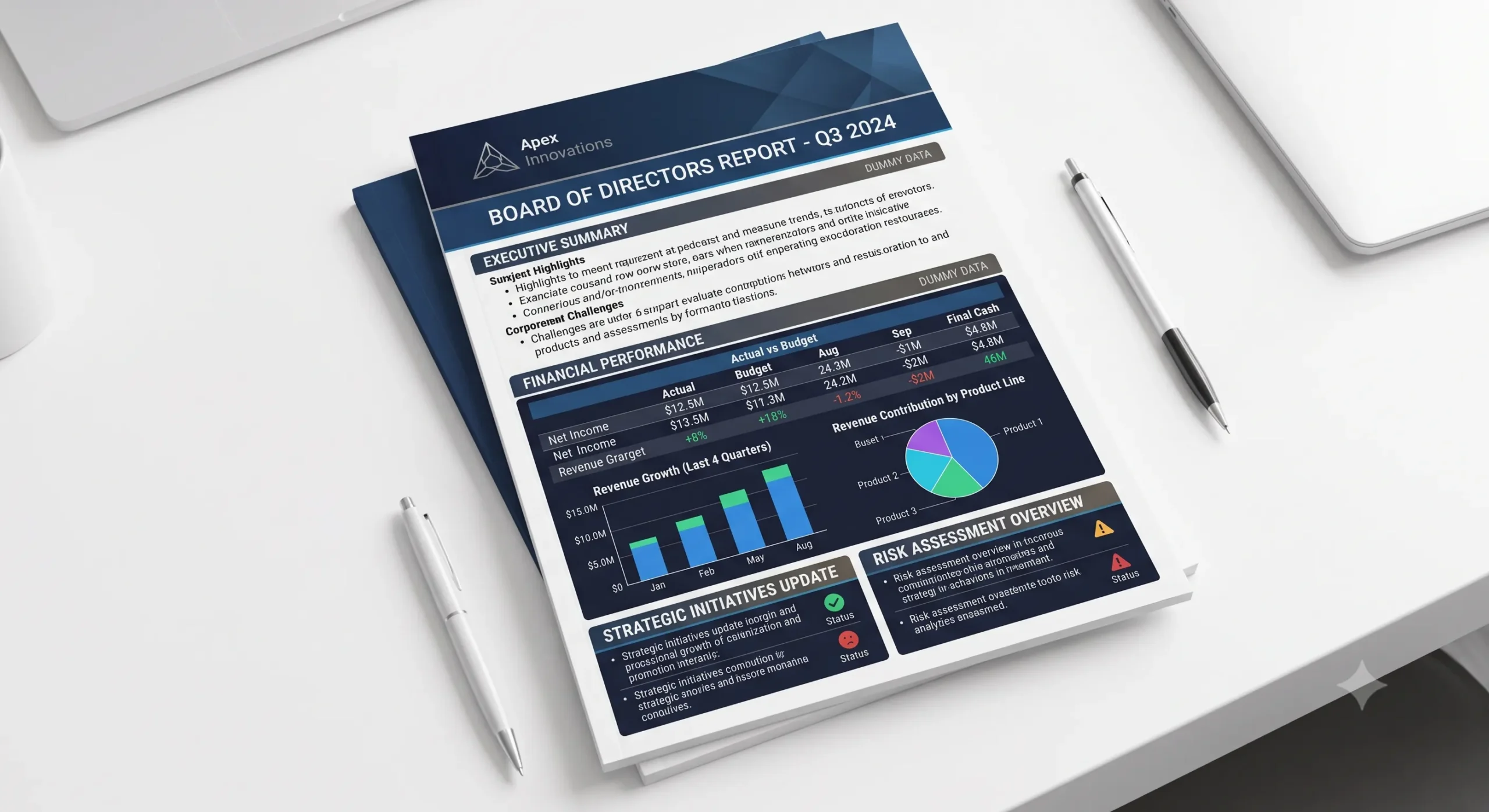
Illustrative example only. Actual reports are tailored to each client’s business model, industry, reporting requirements and available data.
Why this matters: founders, owners and directors can see performance, risks and next actions before approving hiring, funding, pricing, expansion or capital decisions.
What Your Executive Dashboard Shows Every Month
Imagine opening your dashboard on Monday morning. Instead of checking your bank balance and hoping everything is under control, you immediately see the numbers that matter most and the actions requiring your attention this month.
Cash and Commitment View
- Available operating cash: what is genuinely free after committed payments are considered.
- 12-week forecast: receipts, payroll, suppliers, tax, superannuation, loan payments and planned investment shown week by week.
- Pressure points: the weeks where action is required before cash becomes tight.
Performance and Margin View
- Profitability by driver: job, project, client, practitioner, location or service line depending on how your business makes money.
- Budget variance: where revenue, labour, materials, overheads or delivery costs moved away from plan.
- Margin leakage: the activity that looks busy but is not producing the return required to fund growth.
Director Decision View
- Decisions due now: hiring, equipment, pricing, funding, expansion or cost decisions that need management attention.
- Scenario impact: what happens to cash and profit if revenue changes, costs increase or collections slow down.
- Recommended actions: practical next steps from your Chartered Accountant-led advisory team before the next meeting.
A Dashboard That Turns Financial Data Into Decisions
This is the type of executive view we use to focus the conversation on revenue, margin, cash, risk and the decisions that need attention now. The goal is not to give you more numbers; it is to make the next decision clearer.
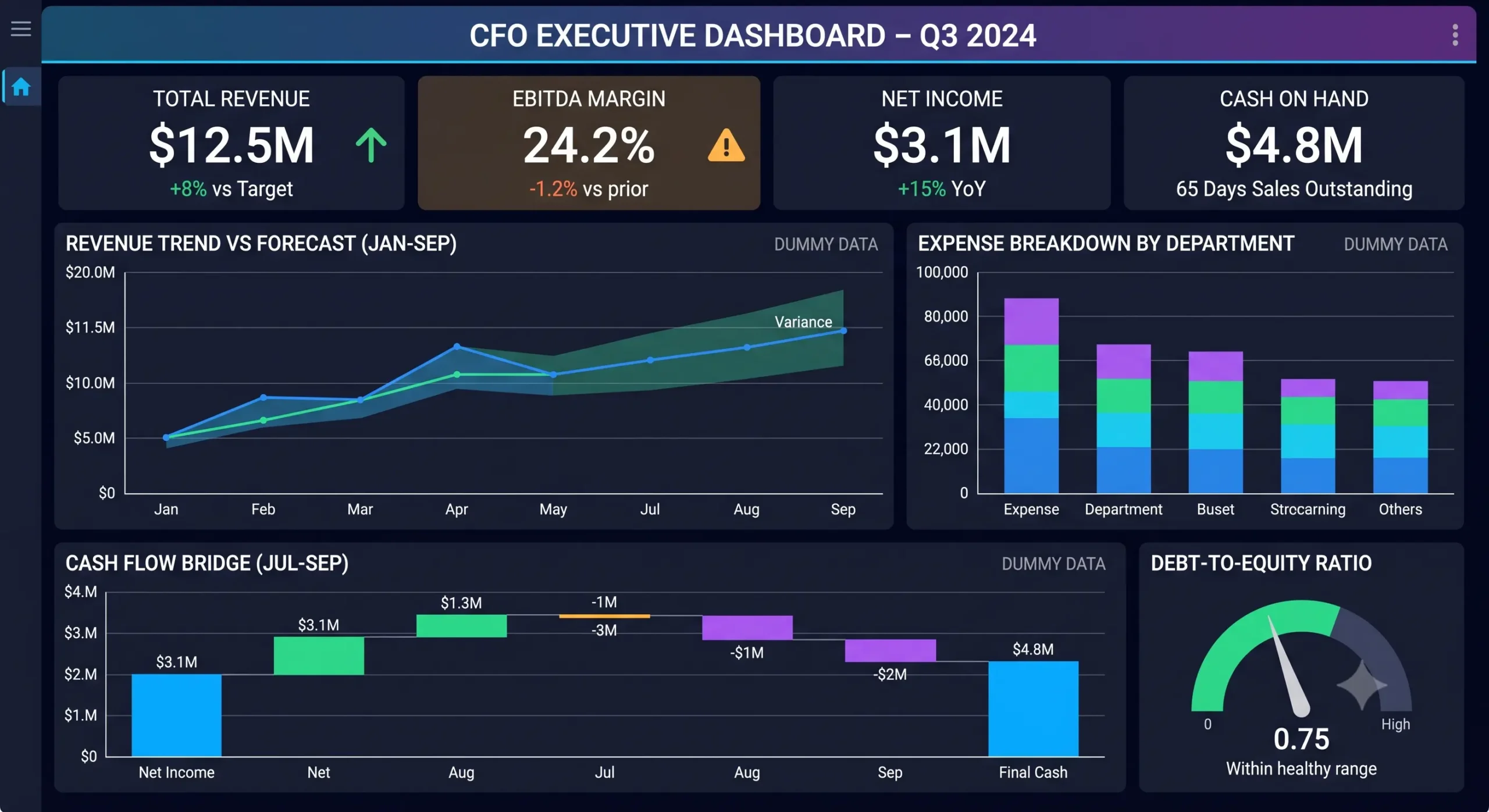
Illustrative example only. Dashboard layout, KPIs and reporting depth vary depending on each client’s business stage, systems and advisory scope.
What you should see at a glance: whether cash is tightening, whether margin is improving, whether debtors need action and which decisions require director approval before the next reporting cycle.
Your Monthly CFO Operating System
The engagement is built around a repeatable management rhythm. Each month you receive the information, interpretation and action plan required to decide what to fund, what to delay, what to fix and what to grow.
Cash Runway and Working Capital
- 12-Week Cash Forecast: Track expected receipts, payroll, suppliers, tax, debt and planned investment week by week.
- Debtor Control: Identify overdue cash, collection bottlenecks and the effect of delayed receipts on commitments.
- Commitment Visibility: Separate cash in the bank from amounts already required for BAS, PAYG, superannuation and loan obligations.
- Early-Warning Actions: Define what management will change before a forecast pressure point becomes a crisis.
Margin and Operational Performance
- Margin Analysis: Measure contribution by project, job, client, practitioner, location or service line.
- Budget Variance: Explain where revenue, labour, materials and overheads moved away from plan.
- Capacity Economics: Link utilisation, delivery capacity and payroll commitments to revenue assumptions.
- Pricing Discipline: Test whether current pricing recovers direct costs, overhead and the margin required to fund growth.
Board Direction and Capital Decisions
- Management Packs: Concise reporting with cash outlook, performance, risk, decisions required and accountable actions.
- Scenario Modeling: Compare base, upside and downside cases before hiring, opening a site or purchasing equipment.
- Funding Readiness: Prepare credible forecasts, assumptions and reporting for lender or investor discussions.
- Decision Governance: Set financial conditions that must be met before major commitments proceed.
Where the engagement also requires specialist tax or funding support, explore our tax advisory services and business finance solutions.
See Cash Pressure Before It Reaches the Bank Account
Before you hire, purchase equipment, approve a supplier run or commit to expansion, the rolling cash forecast shows the weeks where payroll, tax, suppliers, debt and expected receipts collide. That is where Virtual CFO advice becomes practical.
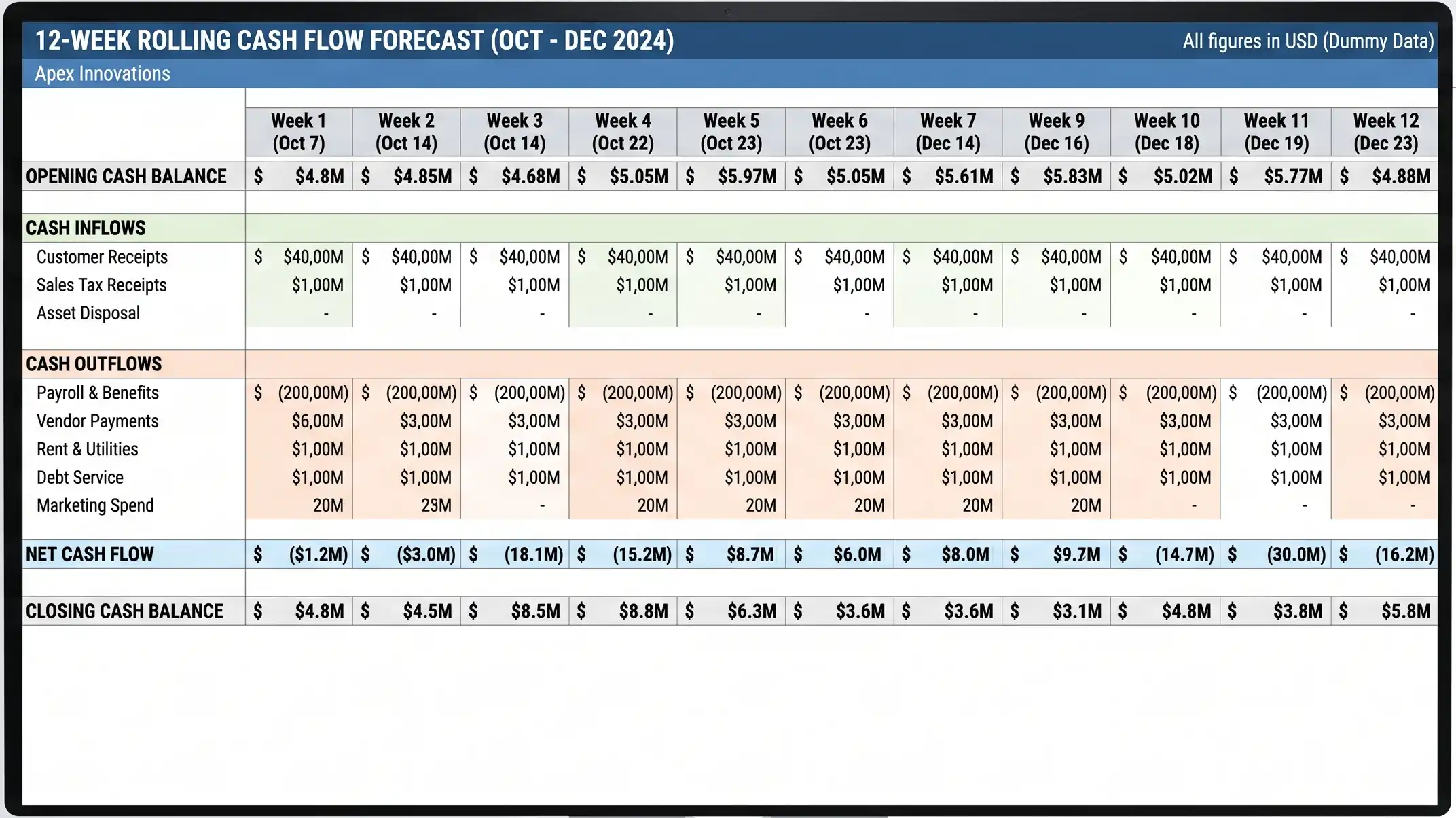
Illustrative example only. Forecast assumptions, categories and timing are customised to each client’s cash cycle, tax obligations and operating model.
What this helps you decide: whether to chase debtors, delay spending, stage a hire, negotiate payment timing, seek funding or hold cash before the pressure becomes urgent.
Decisions That Should Never Be Made Blind
The most expensive finance mistakes usually happen before the transaction is recorded. Fractional CFO support tests affordability and downside before management commits.
Hiring Before the Revenue Is Proven
- Decision Risk: Permanent payroll is added based on pipeline optimism rather than converted demand and cash timing.
- CFO Test: Model salary, on-costs, ramp-up time, utilisation, break-even revenue and the effect on runway.
- Management Outcome: Hire against defined financial triggers—or delay, stage or redesign the role before cash is locked in.
Capital Expenditure Without a Cash Case
- Decision Risk: Equipment, fit-outs or new premises are approved on headline price without considering working capital and timing.
- CFO Test: Compare purchase, finance and lease options against cash flow, utilisation, payback and downside scenarios.
- Management Outcome: Commit only when the business can fund the asset and the operational assumptions are commercially defensible.
Fundraising or Lending Before Reporting Is Ready
- Decision Risk: Management enters lender or investor discussions with inconsistent figures, weak assumptions or no clear use-of-funds model.
- CFO Test: Reconcile historical data, build forecast scenarios and show how capital changes runway, capacity and expected returns.
- Management Outcome: Present a coherent financial case and understand the conditions required to service or deploy the capital responsibly.
Historical Bookkeeping Records the Cost. CFO Leadership Helps Prevent It.
The value is not another spreadsheet. It is the ability to identify a cash, margin or capacity problem early enough to change the outcome.
Earlier Warning, Lower Correction Cost
A rolling model exposes pressure before the bank balance becomes the warning system. Management gains time to accelerate collections, change delivery, defer spend or secure funding on better terms.
Decisions With Financial Conditions
Hiring, pricing, expansion and capital expenditure are assessed against break-even points, runway and downside cases. Decisions proceed when the numbers support them—not because momentum makes them feel urgent.
Controlled Scale Without a Full-Time CFO
You gain senior financial direction, board-grade reporting and an accountable monthly rhythm without carrying the fixed cost of a permanent executive before the business requires one.
How Much Do Virtual CFO Services Cost?
Cost should match the level of decision support required. SAQCH Partners already publishes monthly plans, so this page should answer pricing intent clearly while still directing complex CFO work into a diagnostic review.
Core — From $299 + GST / month
- Best for: Businesses that need annual compliance, basic support and clean foundations.
- Includes: Email support, annual financial statements, business tax return lodgment and two personal income tax returns.
- CFO fit: Useful starting point when reporting is simple and strategic finance needs are limited.
Growth — From $399 + GST / month
- Best for: Growing SMEs that need faster response, annual tax planning and business strategy review.
- Includes: Priority support, annual financial statements, tax returns, annual tax planning, bi-annual strategy review, ASIC review and ATO communication excluding audits.
- CFO fit: Suitable when the business needs structured advice but not regular board-level CFO rhythm.
Premium — From $699 + GST / month
- Best for: SMEs that need regular CFO/strategy sessions, forecasting and scenario planning.
- Includes: Same-day response, comprehensive tax planning, quarterly 2-hour CFO/strategy session, annual budgeting, financial forecasting, scenario planning and variance analysis.
- CFO fit: The strongest published plan for businesses wanting ongoing strategic finance input without a full-time CFO.
Need deeper CFO support? If your business requires monthly board packs, rolling 12-week cash forecasting, multi-entity reporting, funding readiness, construction job-costing, investor reporting or complex margin analysis, start with the 15-Minute Tax & Cash Flow Diagnostic. We will confirm whether Core, Growth, Premium or a customised Virtual CFO engagement is the right fit.
Compare the published SAQCH Partners plans here: Flexible pricing plans for growing businesses.
Questions Scaling Business Owners Ask Before Appointing a Virtual CFO
Direct answers for founders, owners and directors on cash runway, margin control, hiring, capital expenditure, investor readiness and the point where bookkeeping is no longer enough.
See the Financial Impact Before Your Next Growth Decision
Historical bookkeeping tells you what the last decision cost. Live senior financial leadership helps you test the next decision before cash, margin or capacity is committed. Book a 15-Minute Tax & Cash Flow Diagnostic to identify the finance gap most likely to affect your next hiring, funding, pricing, expansion or cash-flow decision.